
What do foodservice, laboratories, and healthcare environments have in common?
Industrial-grade wire shelving.
Wire shelving is one of the most common storage solutions used across commercial environments, from foodservice and healthcare to retail and industrial facilities. But while wire shelving may all look the same, they are not, nor should they be treated as such.
Differences in materials, finishes, system design, and configuration can all impact how shelving performs over time. This means that different applications may benefit from different types of shelving.
In this guide, we’ll cover everything you need to know about industrial-grade wire shelving, including how it compares to solid shelving, different wire finishes, the types available, and the best applications for wire racks.
For a more complete overview of shelving, check out our Commercial Shelving Buying Guide, which covers the major types of shelving.
Learn about industrial wire shelving:
- What is Industrial Wire Shelving?
- The Benefits of Heavy-Duty Wire Racks
- Wire vs Solid Industrial Shelving
- Key Considerations for Wire Shelving
- NSF Certification and Regulatory Compliance
- Common Metal Wire Materials & Finishes
- How to Choose the Right Wire Shelving for Your Environment
- Types of Wire Rack Shelving Systems
- Metro Heavy-Duty Wire Shelving
- Best Applications for Wire Shelves
- Frequently Asked Questions About Wire Shelving
What is Industrial Wire Shelving?
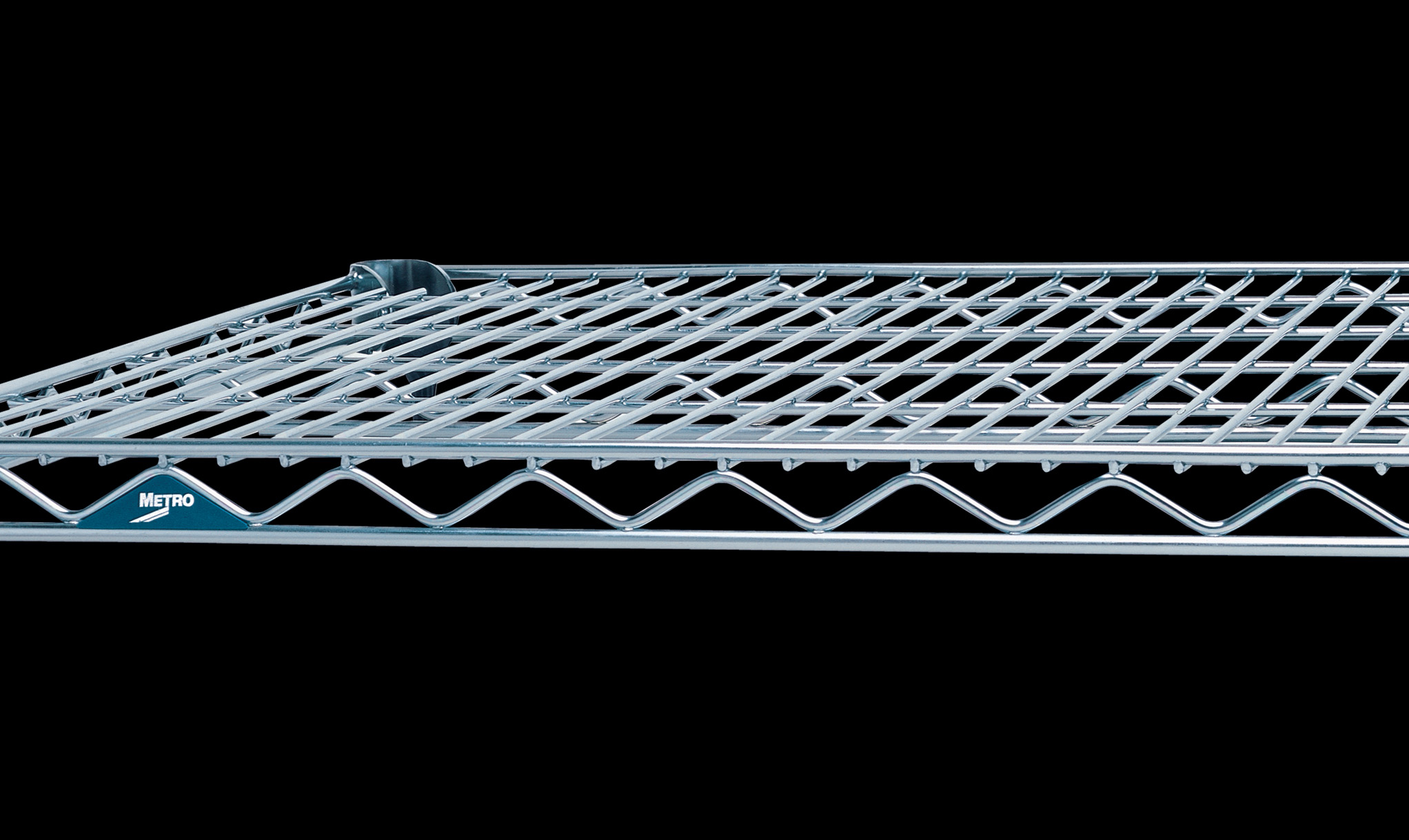
Industrial wire shelving is a heavy-duty storage solution made from welded steel wires that form an open-grid shelf rather than a solid panel. This design gives it an open aesthetic, increasing visibility, reducing dust accumulation, and allowing for better airflow than solid shelf alternatives.
Of course, not all wire shelving performs the same. Materials, construction, and finish are key factors that influence performance and set heavy-duty, industrial-grade wire shelving apart from lighter-duty systems commonly found in residential settings.
Consumer wire shelves designed for home use are lower capacity and intended for basic organization. Commercial and industrial wire shelving, on the other hand, is built to support heavier loads, withstand daily use, and maintain structural integrity in demanding environments. These systems feature reinforced shelf structures, stable post connections, and are available with corrosion-resistant finishes suitable for foodservice, healthcare, laboratory, and warehouse applications.
Heavy-duty systems such as Metro Super Erecta are engineered specifically for high-performance commercial use. They maintain stability under heavy loads, support airflow and visibility, and meet specific standards for safety, quality, and performance such as NSF certification.
Metro Super Erecta is the only wire shelving guaranteed never to collapse.
The Benefits of Heavy-Duty Wire Racks
While wire shelving isn’t the only storage solution on the market, it remains one of the most popular choices among commercial, industrial, and even residential applications because of its many benefits. It’s durable, versatile, easy to clean, and often comes at a lower price point than alternative shelving options, especially for dry storage.
Here are some of the key benefits of wire shelving for commercial applications:
1. Airflow and Ventilation
While airflow may not be the first consideration when choosing shelving, it is important for certain applications and is one feature that sets wire shelving apart from solid shelf systems. In walk-in coolers, healthcare storage areas, and washdown spaces, for instance, poor airflow can lead to condensation, moisture buildup, and potential contamination, which is bad.
The open-wire design allows air to circulate freely around stored items, helping regulate temperature and reduce moisture buildup (this is key in areas where temperature fluctuations are frequent). By promoting ventilation, wire shelving allows wet items to dry more quickly, reducing the risk of corrosion, mold, or product damage.
2. Improved Visibility and Accessibility
A key aspect of proper organization is to find stored items easily. Unlike enclosed storage cabinets, wire shelves provide clear visibility from multiple angles. This makes it easier to locate inventory immediately, which is especially important in fast-paced environments such as foodservice operations or healthcare facilities.
Better visibility also supports organization and inventory management by reducing the time spent searching for items. For organizations following lean principles, this helps eliminate wasted time and can prevent over-ordering/over-stocking. Wire shelving also supports having the right number of tiers to minimize stacking and support inventory management.
3. Reduced Dust and Debris Accumulation
Similarly to providing better airflow and ventilation, the open-grid surface allows dust, dirt, and debris to fall through the shelf rather than collect on it. This helps maintain cleaner storage conditions and reduces the frequency and effort required for maintenance compared to solid surfaces.
In regulated environments, this can support sanitation efforts by minimizing buildup on storage surfaces. However, it is important to note that for some applications (including sterile supply storage), solid bottoms are required on wire shelving units to prevent contamination and protect supplies from debris on the floor.
4. Strength and Load Capacity
While it may be lighter than some solid counterparts—such as pallet racks and cantilevered shelving—industrial wire racks are constructed of steel with a high strength-to-weight ratio. Many industrial-grade systems can handle substantial loads (such as 800 lbs. per shelf), making them suitable for storing a wide range of items, including bulk supplies, equipment, and packa
ged goods.
This level of strength and stability sets it apart from lower-quality wire shelving or light-duty storage systems commonly used in residential settings. When combined with a relatively lightweight, mobile-friendly design, wire shelving provides a practical balance between load capacity and ease of use.
5. Adjustable and Configurable Design
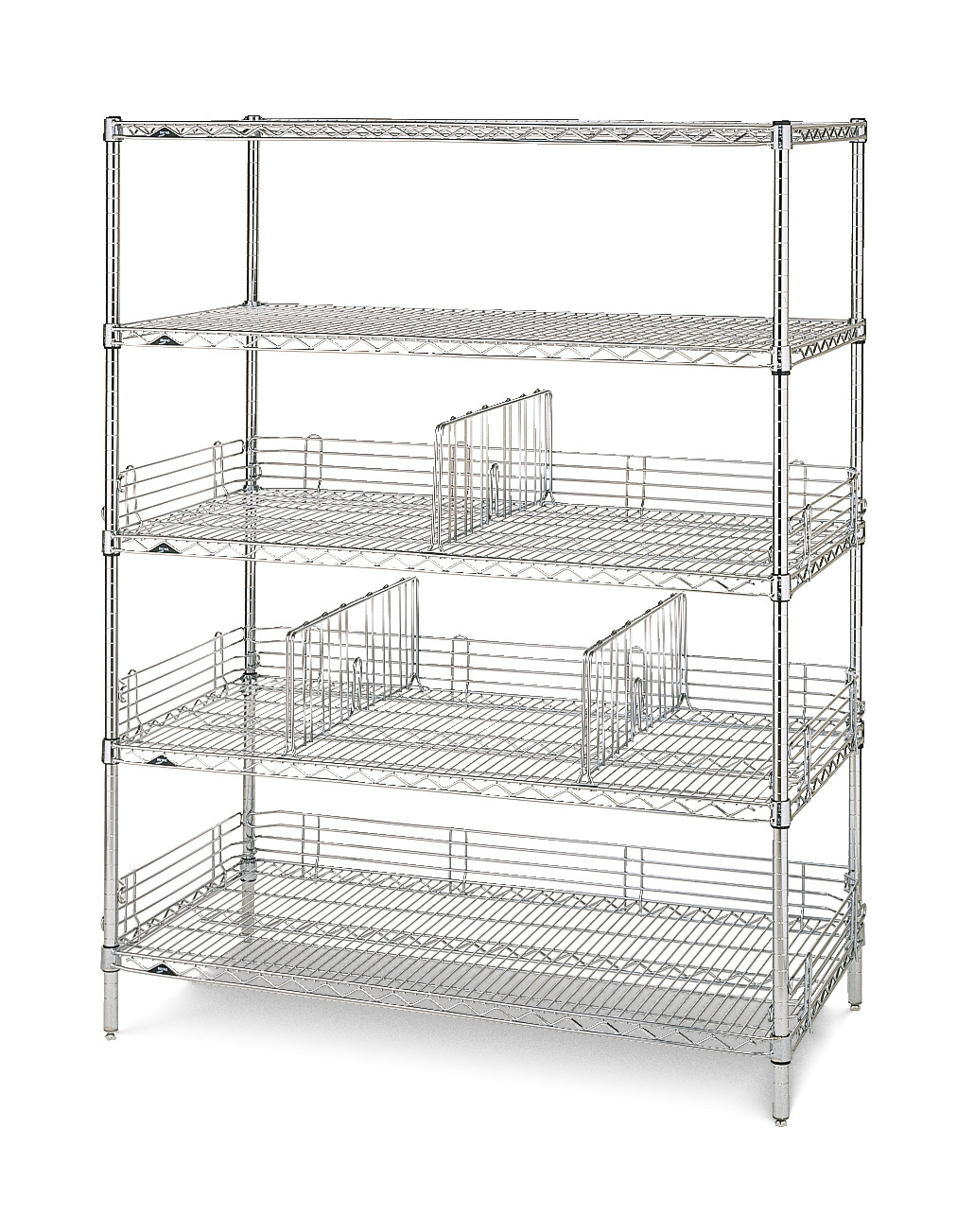
Wire shelving is highly modular, which offers facilities a highly customizable storage solution. Adjustable wire shelves can be repositioned in small increments (e.g., Metro Super Erecta adjusts in one-inch increments) to accommodate items of varying sizes. Shelves and accessories can also be reconfigured, expanded, or combined into stationary, mobile, or high-density systems as storage needs change.
This flexibility allows facilities to adapt layouts without replacing entire units. Metro EZ-ADD shelving takes this configurability to a new level by allowing users to add shelves to their existing units without tools or disassembly.
6. Multiple Finishes for Different Environments
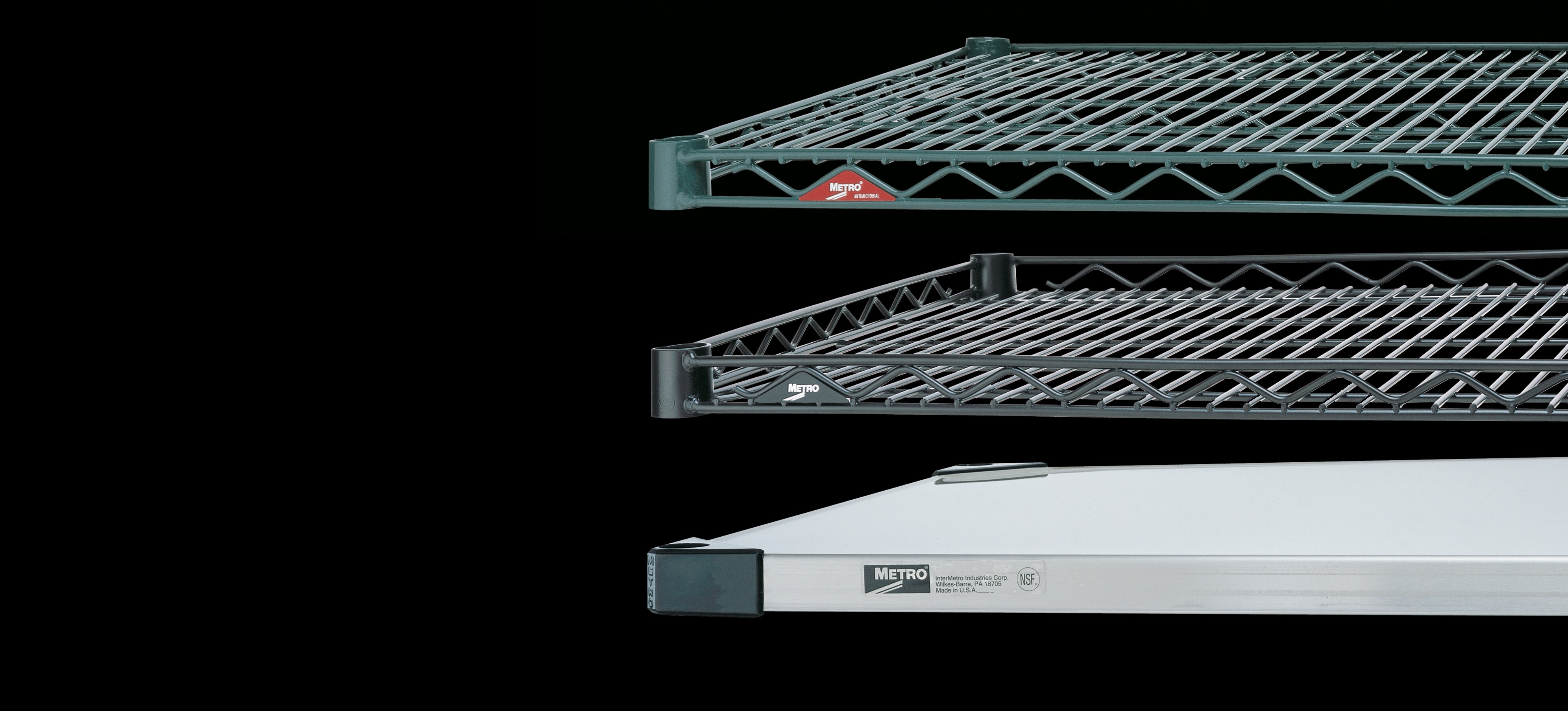
Wire shelving is available in a range of finishes to meet the needs of various applications, including chrome for dry storage, multi-layer epoxy coatings for wet environments, and stainless steel for corrosion-prone or highly regulated areas.
These different finishes provide versatility and enable wire shelving to fit a wide range of applications, including foodservice, healthcare, and commercial. Facilities can select the appropriate level of corrosion resistance and durability based on their environment rather than relying on a single material.
Wire vs Solid Industrial Shelving
Wire shelving and solid shelving are both used in commercial environments, but they serve different purposes depending on how items are stored and the conditions of the space.
Wire shelving uses an open-grid surface, while solid shelving provides a continuous, solid surface. That difference impacts how each performs in day-to-day use.
When comparing the two, there is no universally “better” option. The right choice depends on how the shelving will be used.
Surface and Storage Considerations
Wire shelving works best for items that are stable, packaged, or evenly supported. The open design allows items to sit securely while maintaining visibility across shelves.
Solid shelving is better suited for smaller, irregular, or unstable items that require full surface support. It also prevents items from tipping, shifting, or falling through gaps.
Moisture and Containment
Wire shelving allows liquids and debris to pass through the shelf, which helps prevent buildup in environments where moisture or spills are common.
Solid shelving contains everything on the surface. This can be useful for spill containment or deflection, but it also means liquids and debris collect on the shelf and require more frequent cleaning.
Load Behavior
Both wire and solid shelving are designed for commercial load capacities, but they handle weight differently.
Wire shelving performs best with evenly supported loads, such as boxes or bulk supplies. Solid shelving provides a solid surface that better manages equipment or devices with legs.
When to Choose Wire Shelving vs Solid Shelving
Wire shelving is typically used when:
- Items are boxed, packaged, or stable
- Airflow or visibility is important
- Fire safety (overhead sprinklers can pass through shelves)
Solid shelving is typically used when:
- Items are small, loose, or unstable
- Full surface contact is needed
- Spills or materials need to be contained
- Higher grade stainless steel for chemical resistance (316 stainless steel)
Keep in mind that for some applications, a solid shelf may be required on the bottom of the storage unit even when using wire shelves.
Key Considerations for Wire Shelving
Commercial environments place strict demands on storage equipment, and not all wire shelving is engineered to perform under those conditions. At least, not long-term.
When evaluating industrial wire racks, consider these factors:
Material Quality and Finish
Most commercial-grade wire shelving is constructed from steel, but the finish significantly affects its durability and performance in different environments.
Look for shelving that offers application-specific finishes, such as chrome for dry storage, multi-layer epoxy coatings for improved corrosion resistance, or Type 304 stainless steel for high-moisture or corrosive conditions.
Lower-quality wire shelving may use thinner wire gauges or inconsistent coatings, which can lead to premature corrosion, flaking, or structural fatigue over time.
Weight Capacity
Heavy-duty wire shelving should support substantial commercial loads, with clearly defined weight ratings based on shelf size and configuration. These ratings should be based on evenly distributed loads and remain consistent over time.
For example, Metro Super Erecta wire shelving supports up to 800 lbs. per shelf (when weight is evenly distributed). Shelving systems with lighter construction or thinner wire may not maintain that capacity under constant use or may bow under lighter weight.
Structural Stability
The connection between shelves and posts is a key indicator of long-term performance and overall shelf stability.
High-quality wire shelving systems use secure, full-post engagement and reinforced shelf structures to prevent shifting or collapse. This is especially important in mobile or high-density applications, where shelving is subject to movement and repeated loading.
Systems that rely on loose or poorly fitted components may become unstable over time, leading to wobbling, uneven weight distribution, or failure under load.
Metro wire shelving systems use a proven post-and-shelf connection design to provide consistent stability across stationary, mobile, and track shelving applications.
Metro shelving is the only wire shelving with a Never Collapse Money-Back Guarantee.
NSF Certification and Regulatory Compliance
In many commercial environments, shelving must meet specific sanitation and regulatory standards, particularly in foodservice, healthcare, and laboratory settings.
NSF International develops public health and safety standards for equipment that comes into contact with food, water, and sensitive materials, including shelving systems. NSF-certified shelving has been tested to meet defined requirements for safety, cleanability, and performance.
Wire shelving can be NSF-certified (NSF/ANSI Standard 2 for Food Equipment), and, as with other shelving types, it may be listed for dry environments only or for all environments.
NSF Wire Shelving for Dry Environments
Shelving that has been NSF-certified for dry environments is intended for use in low-humidity areas with minimal moisture exposure. Chrome shelving can be NSF-certified, but only for dry environments since it is not corrosion-resistant enough for dish rooms, walk-ins, or similar applications.
NSF Wire Shelving for All Environments
Shelving certified for all environments has met additional requirements, such as corrosion-resistance testing, and can be used in wet or humid areas (including refrigerators, freezers, and ware washing areas). Type 304 Stainless steel and epoxy-coated wire shelving systems—such as those with advanced antimicrobial or moisture-resistant coatings like Metroseal—meet NSF standards for all environments.
Pro Tip: When choosing wire shelving for regulated environments, looking for the NSF logo isn’t enough. It is important to ensure that the finish and certification level meet the requirements of the given application.
For example, chrome shelving that is NSF-certified for dry environments will inevitably rust if used in a walk-in. If you're experiencing rusty cooler shelving, your shelving may not have the appropriate NSF certification.
Learn more about NSF-certified shelving.
Common Metal Wire Materials & Finishes
While wire shelving is almost always made from steel, commercial and industrial-grade systems can vary in construction and finish. These differences directly impact corrosion resistance, cleanability, and long-term performance.
Understanding how these materials and finishes are built—and how they perform under different conditions—is key to choosing the right shelving for any given environment.
Here are some of the most common commercial wire shelving finishes available:
Chrome-Plated Wire Shelving
Chrome wire shelving is one of the most widely used options in commercial environments, particularly dry storage, due to its cost, versatility, and clean, modern aesthetic.
This finish is created by applying layers of nickel and chrome over a steel wire substrate. The nickel provides a base level of protection, while the chrome finish creates a smooth, durable surface that helps resist abrasion and is easy to clean in dry environments.
Metro Super Erecta chrome wire shelving also features a protective lacquer coating to enhance durability and maintain appearance in low-humidity conditions.
However, despite their versatility, chrome shelves are not designed for moisture exposure or for use in particularly harsh environments. They are intended specifically for dry, low-humidity environments, and prolonged exposure to water or cleaning chemicals can lead to premature corrosion.
Because of this construction, chrome performs best in controlled, dry conditions with minimal exposure to moisture and caustic cleaning agents.
Epoxy-Coated Wire Shelving
Epoxy-coated shelving uses a resin-based coating applied over a plated steel substrate to improve resistance to moisture, chemicals, and surface wear.
At a basic level, epoxy-coated shelving has a protective resin-based coating applied over a plated steel wire substrate. In most commercial systems, the steel is first plated—typically with zinc or a similar material—before the epoxy coating is applied. This creates a coated surface that helps protect the underlying metal from corrosion while maintaining the strength and structure of steel shelving.
Where chrome shelving should only be used in dry storage applications, epoxy-coated wire shelves are suitable for most environments. The additional protective layer provides significantly better resistance to moisture, non-corrosive chemicals, and surface wear.
Of course, not all epoxy coatings perform the same. Every shelving manufacturer has its own specific formulation and process that will affect the performance and characteristics of the shelving. Coating quality depends on factors such as thickness, adhesion, and the type of substrate beneath the coating. Lower-quality systems may be more prone to chipping or surface wear over time, which can expose the underlying metal.
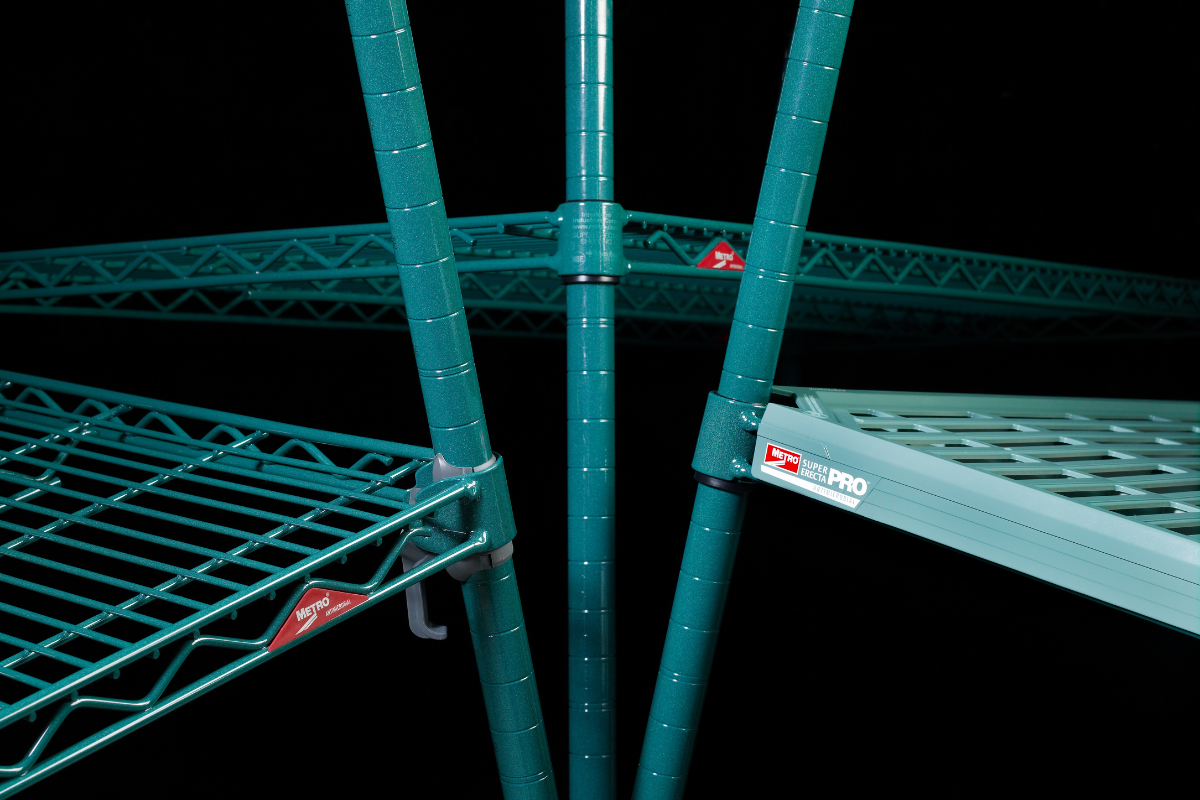
Metroseal® epoxy-coated wire shelving uses a cross-linked epoxy coating applied over a plated steel substrate to create a more durable, corrosion-resistant surface. Metroseal also includes built-in Microban® antimicrobial product protection. Because it is integrated into the finish, Microban will not wear off during use.
Metroseal is available in green and gray finishes.
Stainless Steel Wire Shelving
Stainless steel shelving differs from plated or coated systems because it is made entirely from stainless steel rather than carbon steel with an applied finish. Due to its chemical composition, stainless steel is inherently more corrosion-resistant than standard steel, which is why it is commonly used in more demanding environments.
One of the key advantages of stainless steel is its ability to maintain performance over time. Though the initial cost is significantly higher than other types of wire shelving, its durability does not rely on a surface coating that can wear down or be damaged, giving it exceptional durability.
However, as with most materials, not all stainless steel performs the same. Shelving can be made using different grades of stainless steel, which offer different levels of corrosion resistance at different price points.
In commercial wire shelving, Type 304 stainless steel is one of the most common options. It offers strong resistance to moisture, cleaning chemicals, and general corrosion due to its chromium and nickel content. It offers a good balance of cost, corrosion resistance, and durability.
Sometimes, shelving systems will not have a specified grade or will use lower-quality materials that do not provide the same level of corrosion resistance or long-term durability, particularly in aggressive environments. Always ensure the grade matches its intended application.
Metro stainless steel shelving is available in Type 304 and Type 316.
Learn more about 304 vs. 316 stainless steel shelving
Hybrid Wire Shelving (Wire + Plastic/Polymer Systems)
Hybrid shelving systems combine metal wire construction with heavy-duty plastic (polymer) components to create a more versatile storage surface.
In general, these systems use a wire frame paired with removable or integrated shelf mats that modify the shelf surface. Depending on the design, these mats may be open-grid or solid, providing a smooth surface with a mix of airflow, protection, and containment.
Hybrid wire/plastic racks address some of the inherent tradeoffs of traditional wire shelving. While open wire shelves promote airflow and visibility, they may not be ideal for storing smaller or delicate items. Plastic shelf mats are smooth and removable, which means they can support a wide range of materials and have the benefit of easy cleaning.
Metro Super Erecta Pro shelving combines the benefits of Metroseal epoxy-coated shelving with heavy-duty plastic grid mats for an affordable shelving solution with a 20-year warranty against rust and corrosion.
How to Choose the Right Wire Shelving for Your Environment
Commercial environments place different demands on wire shelving, and choosing the right system depends on how it will be used. The right finish is an important consideration, but it isn’t the only determining factor.
When evaluating wire shelving for commercial applications, consider all of the following:
Environment and Exposure
It cannot be emphasized enough how important environmental considerations are to choosing the right shelving. Everything your shelves are exposed to will directly impact performance and durability of the unit.
Dry storage areas have far fewer limitations. If the shelving will be used to store food containers or other sensitive products, there may be regulatory specifications to consider, but in general, most wire shelving types can be used in dry storage areas, ranging from chrome-plated to stainless steel.
It is when you get to environments with humidity, condensation, or frequent washdowns that get a little trickier. These applications naturally introduce a higher risk of corrosion and require more durable finishes. They may also be subject to regulatory compliance.
Temperature-controlled environments, in particular (such as walk-in coolers), create unique challenges when choosing shelving. Moisture buildup, condensation, and even temperature fluctuations can wreak havoc on shelving. While many people believe that wire shelving cannot be used in walk-ins, it can be—if it has a suitable finish. Chrome should never be used in a walk-in, but NSF-certified for all environments epoxy-coated, stainless steel, and hybrid wire shelving may all be appropriate as long as they meet the other application requirements.
Cleaning and Sanitation Requirements
Few people consider their cleaning protocols when selecting storage solutions, but it is an important factor to consider. The frequency, process, and cleaning solutions used can all affect the longevity and integrity of the shelving over time.
In foodservice, healthcare, and lab environments, shelving may be wiped down daily or exposed to stronger cleaning chemicals. Chrome plating may not tolerate such frequent cleaning in the long run, making Metroseal or stainless steel shelving better alternatives.
Material Quality and Construction
At a glance, wire shelves may all appear the same; however, differences in materials, wire gauge, shelf design, and how components connect can all impact long-term stability and performance. We already talked about the importance of materials and finishes, but it goes beyond that, too.
Look for systems with reinforced shelf structures, secure post connections, and consistent adjustability. Lower-quality shelving often relies on lighter materials (thinner gauge wire) or less secure connections, which can lead to wobbling or reduced load performance over time.
These differences are not always obvious at first but become more apparent with daily use, especially if you can physically see shelves bowing under reasonable loads.
Weight Capacity and Load Conditions
Heavy loads require heavy-duty shelving. While industrial and commercial-grade wire shelving should be able to handle heavy loads, the overall capacity can still vary depending on the system, size, and configuration.
Consider what the shelving will actually hold—both in terms of total weight and how that weight is distributed across the unit. Bulk supplies, equipment, and high-volume storage applications place different demands on the system than lighter or intermittent use.
It’s also important to look beyond individual shelf ratings. Total unit capacity, shelf spacing, and how the shelving is configured all impact overall performance. For instance, a mobile shelving unit will have a lower overall weight capacity compared to the same exact stationary unit because the load capacity is now determined by the casters.
Budget and ROI
Cost is always a factor when choosing shelving, but it should be evaluated alongside expected performance and lifespan. Just because something has a lower upfront cost does not mean it’s going to be cheaper in the long run.
Lower-cost shelving (such as chrome-plated) may work well in controlled, dry environments; however, using that same shelving in applications with frequent exposure to moisture, cleaning chemicals, or heavy use can lead to quicker wear or failure. Replacing shelving units after only a few years because it’s not the right solution can end up being significantly more costly.
It’s important to invest in a system designed for your environment—this helps reduce maintenance, replacement costs, and downtime over the long term.
Types of Wire Rack Shelving Systems
As a highly versatile storage solution, wire shelving is available in a range of configurations to support different storage needs across commercial and industrial environments.
Here are some of the most common types of wire shelving systems:
Stationary Wire Shelving
Stationary (also known as static) wire shelving is a common configuration for long-term, high-capacity storage. They provide maximum stability for applications where the unit does not need to be moved frequently, either for cleaning or reconfiguring a room’s storage layout.
Because they do not use casters, static shelving units can support higher overall weight capacities. The lack of casters is also their biggest limitation. They have less flexibility for movement, so once installed and loaded, these units are more difficult to move than mobile systems.
Common uses for stationary wire shelving include:
- Dry storage areas
- Bulk supply storage
- Medical and lab supply rooms
- Retail backrooms
- Warehouse storage
Mobile Wire Shelving
Mobile wire shelving offers the same structure and adjustability as stationary units with the added benefit of more flexibility. Mobile units have casters, which allow them to be moved for cleaning, restocking, or reconfiguring storage layouts.
Most mobile shelving units have locking casters to ensure the shelf remains stable when not moving; this makes them suitable for both temporary and long-term storage. Of course, as with the various types of shelving available, there is a wide range of casters best suited for different applications.
The biggest trade-off is that mobile shelving typically has a lower total load capacity than stationary systems because the weight is transferred to the casters.
Common uses for mobile wire shelving include:
- Healthcare supply transport and storage
- Walk-in cooler and freezer storage
- Foodservice prep areas
- Back-of-house storage
- General supply movement and restocking
- Environmental chamber storage
High-Density/Track Wire Shelving
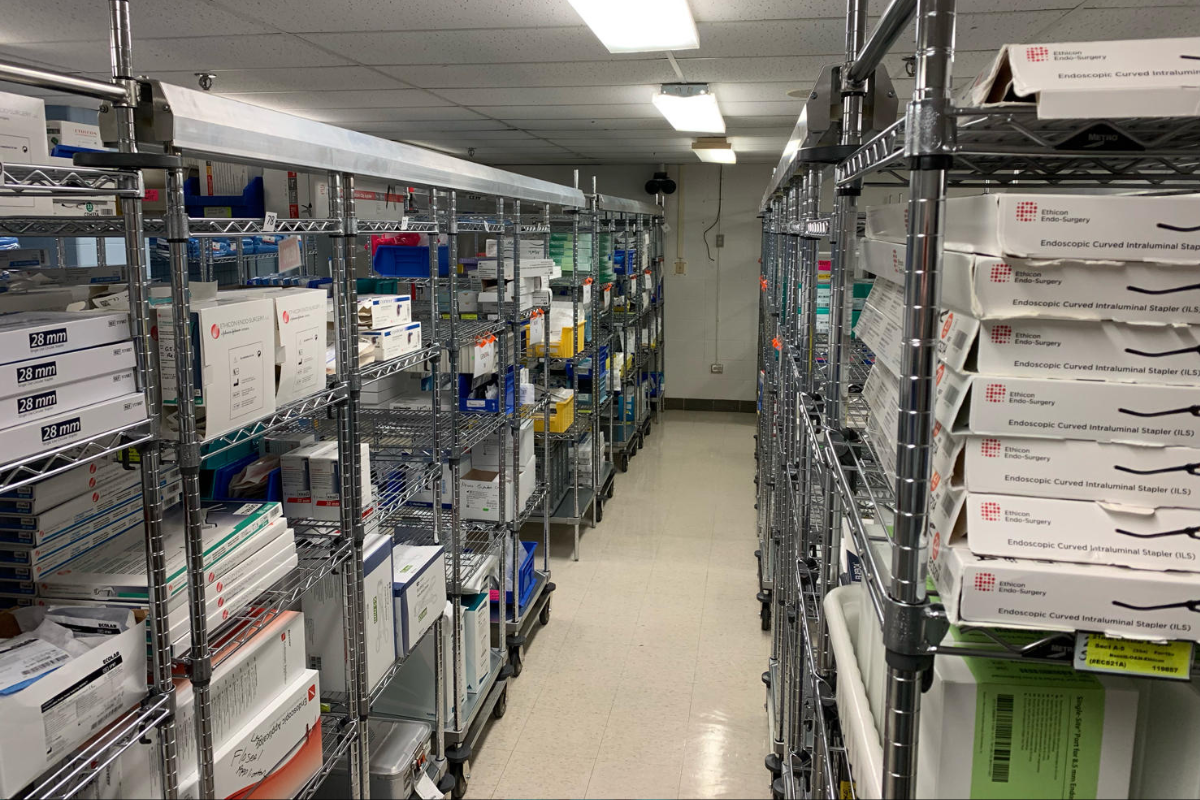
High-density track shelving increases the available storage capacity within a given space without expanding the physical footprint. These systems use mobile shelving units on either floor-mounted or overhead tracks, creating a single active aisle instead of multiple fixed aisles.
By reducing unused aisle space, high-density systems can significantly increase storage within the same area up to 50%.
Metro Super Erecta wire shelving can be used with Metro Top-Track (overhead track) and qwikTRAK (floor track) systems to maintain airflow and visibility even in compact layouts.
Common uses for high-density wire shelving include:
- Walk-in coolers and freezers
- Healthcare storage and SPD environments
- Laboratories and research facilities
- Pharmacy and medication storage
- Back-of-house storage with limited space
- Controlled environment storage
Wire Wall Shelving
Wall-mounted shelving adds storage capacity without taking up floor space. Unlike traditional mobile and stationary units, these are installed directly onto walls, creating storage above workstations, sinks, or equipment—valuable vertical spaces that are typically underutilized.
Wire wall shelving provides the same airflow and visibility benefits as standard wire shelving while improving space efficiency. Metro SmartWall takes wall shelving a step further by introducing an entire productivity system. It uses storage shelves, grids, and accessories to create more storage space and task-oriented workstations.
Common uses for wire wall shelving include:
- Foodservice prep areas
- Dish rooms and wash areas
- Chemical storage
- Above base storage or equipment
- Lab and healthcare supply zones
Wire Security Shelving
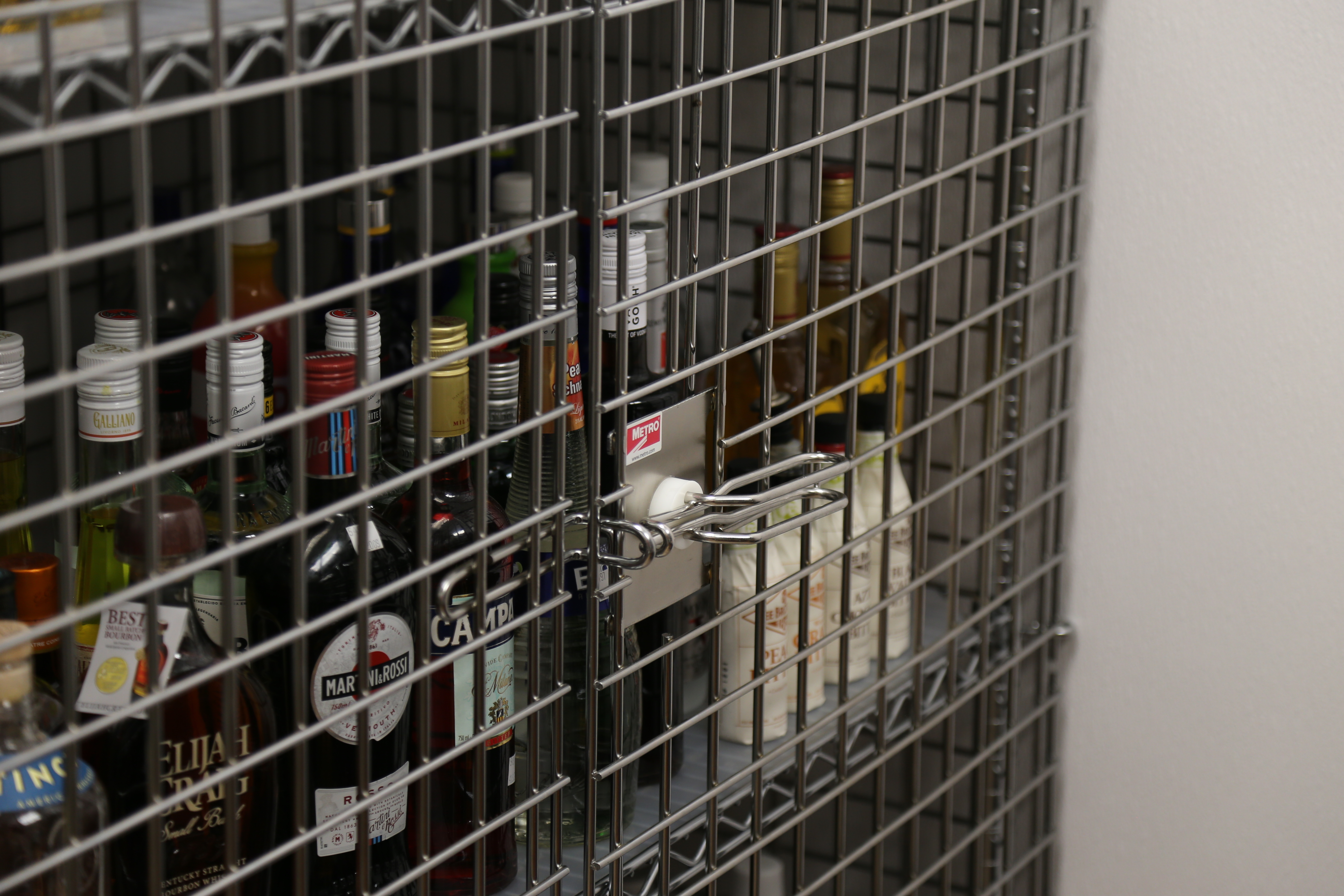
Security shelving provides a means to restrict access to stored items while maintaining visibility. These systems include locking enclosures, panels, or doors built around standard wire shelving units.
These systems are commonly used where access control is required without sacrificing visibility or organization. Mobile models are easy to move between locations and can even be integrated into high-density storage systems. Metro security shelving units are available with a traditional swing door or sliding door for space-saving convenience.
Common uses for security wire shelving include:
- BOH liquor storage
- Healthcare supply areas
- Tool or equipment storage
- High-value inventory storage
- Controlled or restricted-access environments
Wire Shelving Carts
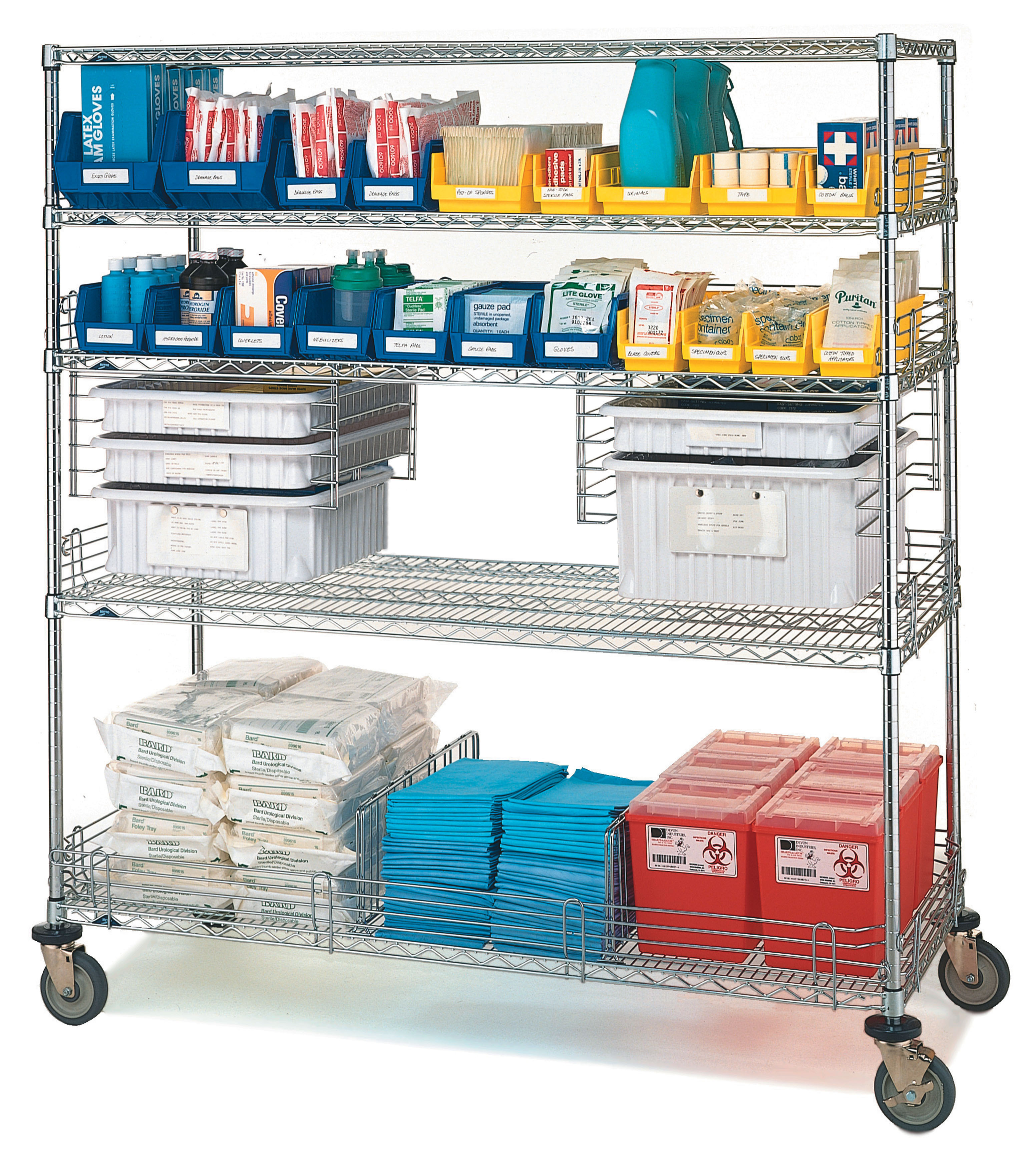
Wire shelves can also be configured as carts specifically for transport and workflow efficiency. They function similarly to mobile shelving units but are often smaller and built with additional features to support movement, handling, or specific tasks, including a handle.
Two- and three-shelf wire carts are commonly used to move supplies between areas while maintaining organization and accessibility. Taller four- and five-shelf carts are commonly used for picking, staging, and delivery applications.
Because they are used in motion, proper configuration is important to ensure stability under load. They are also available in multiple finishes to fit a wide range of applications, including chrome for general supplies and stainless steel for lab use.
Common uses for wire shelving carts include:
- Material handling and transport
- Healthcare supply distribution
- Foodservice operations
- Restocking and inventory movement
- Picking carts
Wire Dunnage Shelving and Racks
Wire dunnage racks keep heavy or bulk items off the floor, protecting them from moisture, condensation, and contamination. They typically have higher weight capacities than traditional shelves, improve airflow around stored items, and allow for easier cleaning underneath. Dunnage shelves are specifically designed to withstand the impact from heavy items being loaded daily.
Dunnage supports health and safety code requirements for storing items at least 6 inches off the floor while maintaining airflow and minimizing dust accumulation. Individual dunnage racks can store stacks of oversized boxes that don’t easily fit on traditional shelving units.
Metroseal dunnage racks can be used in refrigerated environments.
Common uses for wire dunnage shelving include:
- Bulk food storage
- Cold rooms and freezers
- Industrial and warehouse storage
- Healthcare and lab supply areas
- Applications requiring frequent floor cleaning
Specialty Wire Shelving
Some applications require more specialized configurations beyond standard shelving systems. Wire shelving can be adapted to support these needs.
Metro also offers these specialized wire racks:
Metro Heavy-Duty Wire Shelving
Metro has been a leader in wire shelving for over seventy years, with some of the most widely used shelving systems in commercial and industrial environments. But when you think of Metro wire, we offer more than one kind of shelving.
Most Metro wire shelving is built on a common platform: open-wire shelves combined with a modular post-and-shelf design to support a wide range of configurations, including stationary storage, mobile applications, and high-density track systems.
Several core design elements are consistent across most Metro wire shelving systems:
- Steel wire shelf construction designed to support commercial load requirements
- Open-grid shelves that promote airflow, visibility, and reduced dust buildup
- Shelves that adjust in 1-inch increments along the full height of the post
- A modular system that supports stationary, mobile, and high-density configurations
- Compatibility across shelves, posts, accessories, and add-on components
- Availability in multiple finishes, including chrome, multi-layer epoxy-coated with Microban, stainless steel, and specialty options
The sections below provide an overview of each Metro wire shelving system.
Super Erecta® Wire Shelving
Super Erecta is Metro’s standard wire shelving system and the foundation for most commercial wire shelving configurations. It uses a traditional post-and-shelf design with split sleeve connectors for easy tool-free assembly.
Because of its flexibility and full compatibility with accessories and add-ons, Super Erecta is typically used as a general-purpose shelving system where storage needs are stable but may evolve.
Key characteristics of Super Erecta:
- Traditional split-sleeve assembly system
- Fully modular and widely configurable
- Available in all finishes
Super Adjustable Super Erecta®
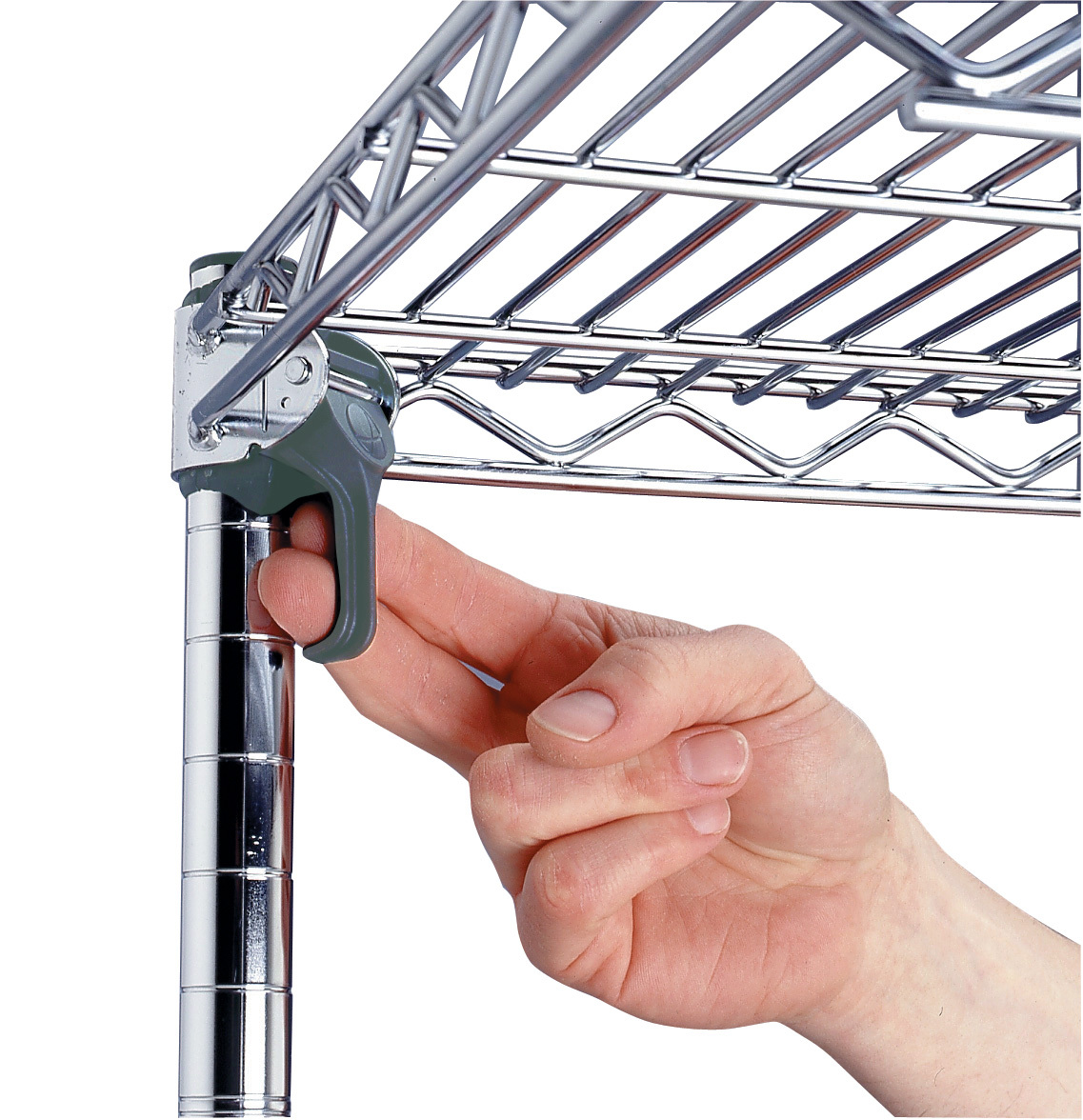
Super Adjustable Super Erecta (SASE) is built on the same core platform as Super Erecta but has an upgraded design to simplify shelf adjustments.
Rather than traditional split sleeves, SASE has a built-in corner release mechanism that allows shelves to be repositioned more quickly without tools or fully disassembling the unit. This reduces labor and downtime when shelf heights change frequently.
SASE is popular in foodservice and healthcare applications where inventory changes often and maximizing vertical space is a priority.
Key characteristics of Super Adjustable Super Erecta:
- Corner release system for faster adjustments
- Reduced labor during reconfiguration
- Compatible with Super Erecta components
- Available in chrome, stainless steel, and Metroseal
Super Erecta Pro®
Super Erecta Pro (SE Pro) is a hybrid wire and plastic shelving system designed to be easier to clean and more durable than conventional wire shelving, while maintaining the strength and structure of Metro wire.
SE Pro combines durable epoxy-coated wire shelf frames with protective heavy-duty plastic shelf mats with built-in antimicrobial protection that resist abrasion and are easy to clean. The antimicrobial shelf mats help preserve the integrity of the coated wire when loaded and unloaded, which is why it’s a popular choice for walk-in coolers and freezers.
Key characteristics of Super Erecta Pro:
- Hybrid design (wire frame + plastic shelf mats)
- Improved surface protection over standard wire shelving
- Maintains airflow and modular flexibility
Best Applications for Wire Shelves
Wire shelving is used across a wide range of industries because it can be configured for different environments, load requirements, and storage layouts. In most cases, the decision to use wire shelving comes down to balancing durability, flexibility, and cost against environmental conditions and cleaning requirements.
Below are some of the most common applications for wire shelving, along with how it is typically specified.
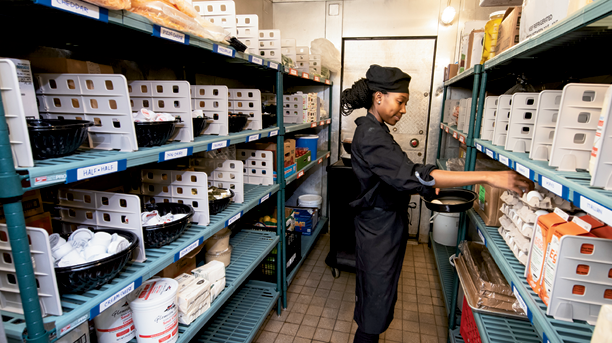
Foodservice & Hospitality
Foodservice operations include a mix of dry storage, refrigerated areas, and wet environments, often within the same facility. This requires shelving that can perform across different conditions while supporting daily use.
Wire shelving is commonly used in the following applications:
- Dry storage for packaged food and bulk ingredients
- Walk-in cooler and freezer storage
- Back-of-house kitchen storage
- General storage and staging areas
- Dish areas/wet zones
- Liquor supply
In these environments, material finish determines whether wire shelving should be used. For example, chrome shelving is only appropriate for dry storage, while multi-layer epoxy-coated wire shelving (or hybrid shelving like SE Pro) is suitable for walk-in coolers and freezers. Stainless steel is a costly alternative for use in wet environments that provides a long-term shelving solution.
Super Adjustable Super Erecta is popular for dry storage, and mobile units are frequently used to support cleaning and reorganization. Wall shelving can maximize vertical space above three-compartment sinks and other areas in a crowded kitchen.
Grocery and Retail Operations
Retail and grocery environments require shelving that can handle frequent restocking, changing inventory, and a mix of dry and temperature-controlled storage.
Wire shelving is commonly used in:
- Backroom and stockroom storage
- Order pick-up areas
- Receiving and staging areas
- Refrigerated storage
- Retail display areas
- General merchandise
Chrome wire shelving is widely used in dry retail storage due to its cost-effectiveness and clean, modern look. For refrigerated environments, however, shelving needs to be durable against rust and corrosion, so Metroseal shelving or hybrid shelving like SE Pro are preferred.
Quick-adjust systems, such as SASE, can be beneficial in areas where shelf heights need to change to accommodate different product sizes, while qwikSLOT can be used in displays.
High-density shelving systems are also used in backrooms to increase storage capacity where floor space is limited.
Healthcare and Medical Facilities
Healthcare storage environments require reliable, organized systems that support equipment and supply storage and transport and support infection control protocols.
Wire shelving is commonly used in:
- Central supply and general storage areas
- Clean utility rooms
- Equipment and consumable storage
- Non-sterile storage environments
- Mobile storage and transport applications
- Patient care areas
Chrome shelving is typically used in dry storage areas, while epoxy-coated or stainless steel shelving is used in areas with more frequent cleaning or moisture.
High-density track systems are often used to maximize storage in space-constrained supply rooms. Quick-adjust wire options like Metro Super Adjustable and EZ-ADD shelving promote dense storage units for organizing storage bins, including two-bin kanban.
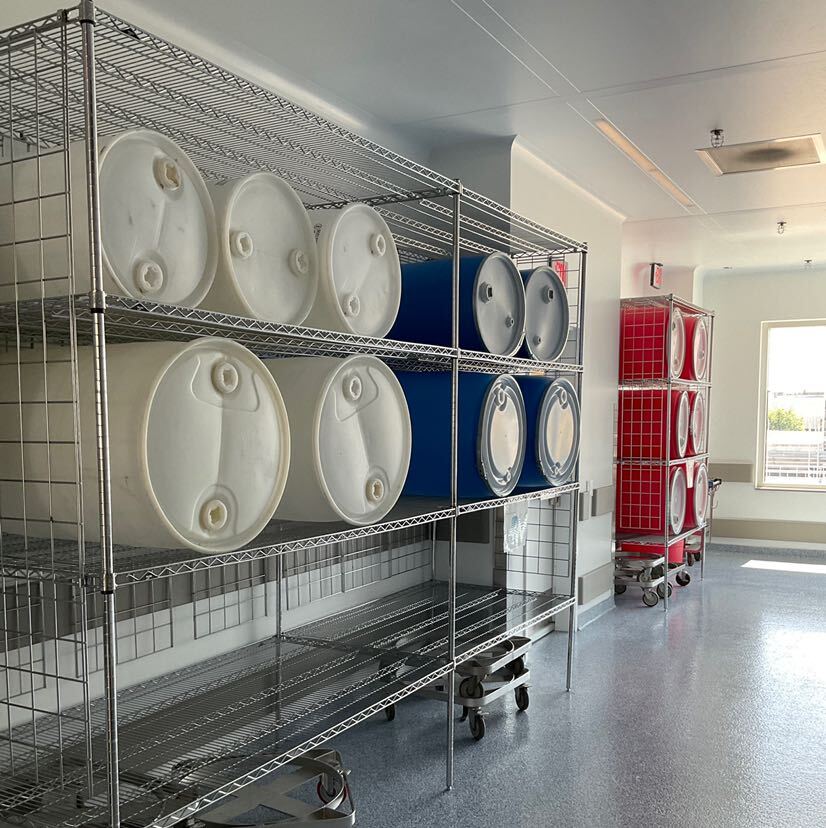
Laboratories and Controlled Environments
Generally, labs and other controlled environments require shelving that is hygienic, non-shedding, and resistant to moisture and chemical exposure.
Wire shelving is commonly used in:
- General lab storage
- Equipment and supply storage
- Cleanrooms
- Chemical storage areas
Type 304 stainless steel shelving is the most common type of wire shelving for lab use because it’s non-corrosive, easy to sanitize, and highly resistant to chemicals, moisture, and bacteria. Epoxy-coated shelving may be used in less aggressive environments.
Additional accessories or alternative shelving surfaces may be required where small items or liquid containment are a factor.
Industrial and General Commercial Storage
Industrial and commercial storage applications often involve heavier loads, less controlled environments, and long-term use.
Wire shelving is commonly used in:
- Warehouse storage and bulk inventory
- Maintenance and utility storage areas
- Material handling and staging zones
- General commercial stockrooms
Chrome wire shelving is commonly used in dry warehouse environments, while epoxy-coated or stainless steel units are preferred in environments with moisture or chemical exposure.
Mobile shelving units and dunnage shelving may be used to support workflow and heavy-load storage.
Find the Right Wire Shelving with Metro
Choosing the right wire shelving comes down to understanding how your environment, storage needs, and workflow all work together. Factors like moisture exposure, load requirements, finish selection, and system configuration all play a role in long-term performance.
Nobody knows wire shelving like Metro. We offer a full range of wire shelving solutions to support different applications across commercial and industrial environments.
Not sure where to start?
We're here to help. Contact us today or reach out to your local Metro rep to optimize your storage.
Frequently Asked Questions About Wire Shelving
How much weight can wire shelving hold?
Wire shelves, especially industrial-grade wire shelving, can hold a substantial amount of weight, with many commercial shelves rated up to 800 lb. per shelf. Please note that the exact load rating depends on shelf size, model, and casters (if mobile shelving). The safe load capacity also applies to evenly distributed weight. Always verify the specification for the specific wire shelf you’re buying.
What are the main uses for wire shelving?
Wire shelving is one of the most versatile storage solutions for commercial and residential use and can be used just about anywhere. Because the open-wire design improves airflow and visibility, wire shelving is popular in foodservice and hospitality applications for organizing dry goods, small wares, and bulk supplies. The design also makes it easier to keep products dry, clean, and easy to find.
Beyond foodservice, wire shelving is popular in healthcare facilities, labs, and industrial spaces for many of the same reasons; it supports cleanliness, quick access, and flexible organization for medical consumables, lab materials, packaged goods, etc. Because shelves can be adjusted and reconfigured as needs change, wire shelving works as a long-term storage solution in environments where layouts, inventory, and workflows fluctuate.
What are the cons of wire shelving?
While there are many benefits to wire shelving—it’s affordable, strong, and offers good airflow—it’s not suitable for all applications. Due to the open-wire design, wire shelves can be problematic for very small, soft, or oddly shaped items without shelf mats. And while wire allows airflow and can reduce dust accumulation on the shelf, it will not contain spills, and debris can fall to the floor.
Another consideration is the finish. Chrome wire shelving is widely used but isn’t durable in all environments; it’s susceptible to rust if exposed to humidity, spills, or cleaning chemicals. However, epoxy-coated wire and stainless-steel shelving minimize or eliminate the chance of rust or corrosion when exposed to such conditions.
Can wire shelving be used in walk-in coolers or freezers?
Wire shelving can be used in walk-in coolers and freezers and performs well if the finish is suitable for the environment. The open-wire design allows air to circulate freely around stored products, which helps maintain consistent temperatures, reduce condensation, and prevent frost buildup.
Standard chrome wire shelving is designed for dry storage and will corrode in cold, damp conditions. For that reason, it’s not recommended for long-term use in wet or refrigerated spaces. Epoxy-coated or stainless-steel wire shelving is better suited to handle moisture, temperature fluctuations, and frequent cleaning without breaking down.
How do I clean wire shelving?
Cleaning wire shelving is a straightforward process, which is one of the many reasons it is widely used in foodservice and healthcare applications. If necessary, start by removing items from the shelves. Wipe away loose debris, then clean the shelves with a mild detergent or approved cleaning solution using a cloth or soft brush to reach the wire intersections. Rinse thoroughly and allow the shelves to air dry completely before restocking. Avoid using caustic cleaning agents on chrome-plated wire shelving, as this finish is more susceptible to corrosion.
Does wire shelving rust? How do you prevent wire shelving from rusting?
Wire shelving can rust, but it depends almost entirely on the finish and the environment it’s used in. Rust is a type of corrosion (oxidation) that occurs when iron reacts with oxygen and moisture. Most standard wire shelves are made of iron alloys, such as mild steel, and can rust if their protective coatings are scratched or exposed to moisture. That’s why application is very important to the longevity of shelving.
For example, chrome-plated wire shelving is intended for dry storage, and if it’s exposed to moisture or humidity—like in a dish room, walk-in cooler, or freezer—it can corrode over time, resulting in rusty flakes. To prevent rust, the key is selecting a finish designed for your environment. In wet, cold, or high-humidity areas, Metro epoxy-coated or stainless-steel shelving are preferred. The former has a protective layer over the steel to resist rust and corrosion (Metroseal), giving it a 15-year warranty against rust, whereas high-quality stainless steel naturally resists corrosion across a wide range of conditions.
Is wire shelving NSF certified?
Many wire shelving systems, including Metro wire shelving, are NSF certified, but it depends on the individual product and finish. In commercial environments, NSF certification means the shelving has been independently tested to meet strict standards for cleanability, material safety, and corrosion resistance. Such standards make the shelving suitable for foodservice, healthcare, and other regulated applications.
However, not all shelving is approved for the same conditions. NSF listings indicate whether shelving is approved for all environments (including walk-in coolers and freezers) or limited to dry storage and heated environments only. Stainless steel and multi-layer epoxy-coated wire shelves may meet NSF standards for all environments, but chrome shelving should only be used in low-humidity areas with minimal moisture exposure.