
Healthcare facilities are under pressure to do more with the space and resources they already have. Many hospitals were designed decades before today's equipment, technology, and patient volumes became the norm. At the same time, more services, documentation, monitoring, treatment, and clinical decision-making have moved to the bedside.
Where patients used to travel to receive services, those same services increasingly travel to the patient. This can easily lead to overcrowded spaces, particularly patient rooms, which must now accommodate caregivers, equipment, supplies, and technology without compromising accessibility.
For many organizations, this change in care has led to a greater focus on space-efficient equipment and point-of-use storage solutions. Small medical carts are one example. Their compact footprint, mobility, and configurable storage help bring supplies closer to the point of care while making better use of existing space.
Here are five reasons healthcare facilities are choosing small medical carts.
1. Maximize Limited Space
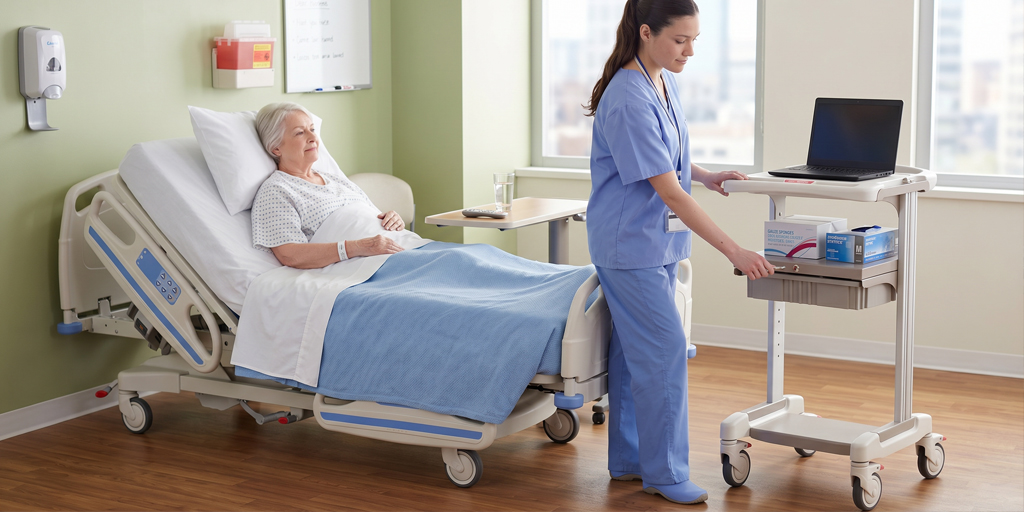
Patient rooms, recovery bays, infusion centers, emergency departments, and outpatient treatment areas must accommodate more equipment than ever before. Beds, IV poles, infusion pumps, monitors, mobile workstations, and supply carts all compete for limited floor space.
A smaller medical cart provides the storage needed for a specific workflow without adding unnecessary bulk. Its compact footprint makes it easier to position near the patient, navigate around equipment, and fit comfortably into active care areas.
For example, phlebotomists often move between rooms for specimen collection. A compact phlebotomy cart can make blood draws easier by keeping necessary supplies close at hand without adding a bulky cart to an already crowded space.
For facilities looking to optimize existing space when renovations or expansion aren’t possible, small medical carts provide a practical way to improve organization without increasing congestion.
2. Keep Essential Supplies Within Reach
When supplies are readily available, caregivers spend less time retrieving them and more time focused on patient care.
Small medical carts can be stocked for a specific task—such as wound care, phlebotomy, bedside treatments, or IV therapy—keeping frequently used supplies close at hand. Instead of relying solely on central storage, departments can place dedicated carts where they're needed most.
Because these carts are designed around a specific purpose, they stay organized and are less likely to become catch-all storage units.
3. Improve Mobility
Healthcare staff rarely work in one location for long. Throughout the day, they move between patient rooms, departments, and treatment areas, bringing supplies with them. Every unnecessary push, pivot, and retrieval trip adds to an already physically demanding shift.
Small medical carts are easier to maneuver through tight spaces, around patient beds, and between medical equipment. Their lighter weight and compact design make it easier to reposition and transport, particularly in busy clinical environments.
Limiting unnecessary strain helps make routine tasks easier to manage throughout a shift.
4. Support Lean Inventory Management
Small medical carts encourage a more disciplined approach to inventory. Rather than storing every possible supply, they are stocked with only what's needed for a specific task or department.
This focused approach reduces overstocking, simplifies inventory management, and makes it easier to monitor supply levels and rotate products before they expire. It also helps ensure frequently used items remain available without wasting valuable storage space.
The goal is not to move more supplies into the care area, but rather to ensure the right supplies are close to the work being performed. For facilities pursuing lean healthcare initiatives, smaller carts naturally reinforce better inventory practices.
5. Configure Carts for Specific Workflows
Small medical carts are most effective when they're designed around a specific workflow.
A wound care cart requires different supplies than a phlebotomy cart or an isolation cart. By configuring each cart for its intended use, facilities can organize supplies more efficiently and make them easier for staff to locate during patient care.
Purpose-built carts are also easier to stock, maintain, and replenish because every drawer, shelf, and accessory has a defined role.
Metro Nimbl® Small Medical Carts
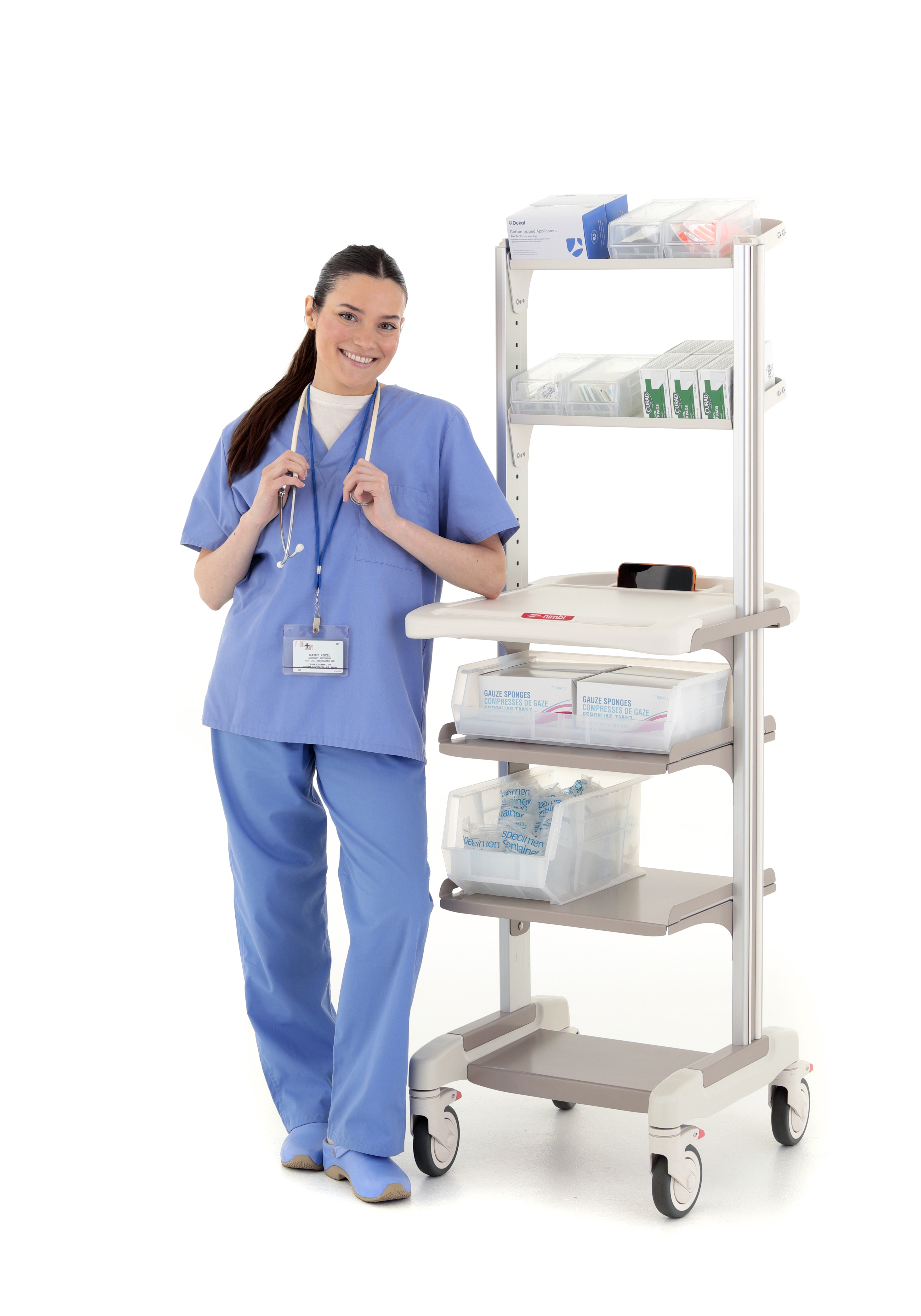
Metro designed Nimbl® medical carts for departments that need organized storage without the footprint of a traditional supply cart.
Available in multiple sizes and application-specific configurations, Nimbl carts support wound care, phlebotomy, isolation, dialysis, emergency departments, bedside care, and general nursing workflows. Each cart features an ergonomic work surface for labeling, charting, staging supplies, and other point-of-care tasks while maintaining a compact footprint that's easy to manage in busy clinical environments.
Why Choose Metro Nimbl?
- Compact footprint: Provides organized storage and a usable work surface while fitting comfortably into space-constrained care areas.
- Easy mobility: Lightweight construction and brake-lock casters make the cart easy to move, reposition, and secure.
- Ergonomic work surface: Standing-height design with a raised perimeter and rear utility trays supports quick preparation and point-of-care tasks.
- Balanced storage: Keeps essential supplies organized without unnecessary compartments or excess bulk.
- Modular flexibility: Rails, shelves, bins, drawers, and accessories allow the cart to be configured for a variety of clinical applications and workflows.
Find the Right-Sized Medical Cart
Not every clinical task requires a full-size supply cart. Smaller medical carts give healthcare facilities a flexible way to improve organization, keep essential supplies within reach, and make better use of limited space.
Explore Metro Nimbl medical carts to find a configuration that fits your department, workflow, or facility-wide storage needs.